
Forest Bathing
Shinrin-Yoku, the Forest Therapy
The Angle
Almost every book in this category promises transformation. This one opens by telling you that you will stand in a wood, feel nothing at all, produce a mental shopping list, and feel faintly ridiculous.
Then it tells you to stay anyway.
“Almost everyone who tries forest bathing once and gives up left during the boring part.”
That honesty runs through the whole book. There is a chapter on when the forest is not the answer. There is a passage on the day the practice simply did not work and the author went home in a worse mood than he arrived. There is a full bibliography at the back, so a reader can check every claim.
Written for North American Forests
Most books on shinrin-yoku translate Japanese advice and leave the reader to guess which tree is which. This one names its ground — and it is written in US English, for the woods an American or Canadian reader already has.
A French author’s practice, carried across the Atlantic and set down among American trees by name — not generic advice translated from Japanese.
Five Story Angles
- The honest wellness book. A genre built on promises, and a book that begins with a confession. Quotable, contrarian, and true.
- First book in his sixties. Joubert practiced tai chi and qigong for decades, noticed something under trees near Lyon in 1990, and told nobody. He published his first book in 2023, in his sixties, having assumed his whole life that writing books was something other people did, elsewhere, with permission.
- The name on the cover is a debt. Firmin was his godfather, who together with his wife looked after him as a small boy in Le Puy-en-Velay while his parents worked in the town’s lace industry. Writing under his name is a way of keeping him close.
- Science, including the uncertainty. Lower cortisol, slower heart rate, immune-activity changes, reduced amygdala activity after a single hour among trees (Molecular Psychiatry, 2022). And a clear statement of what remains unproven.
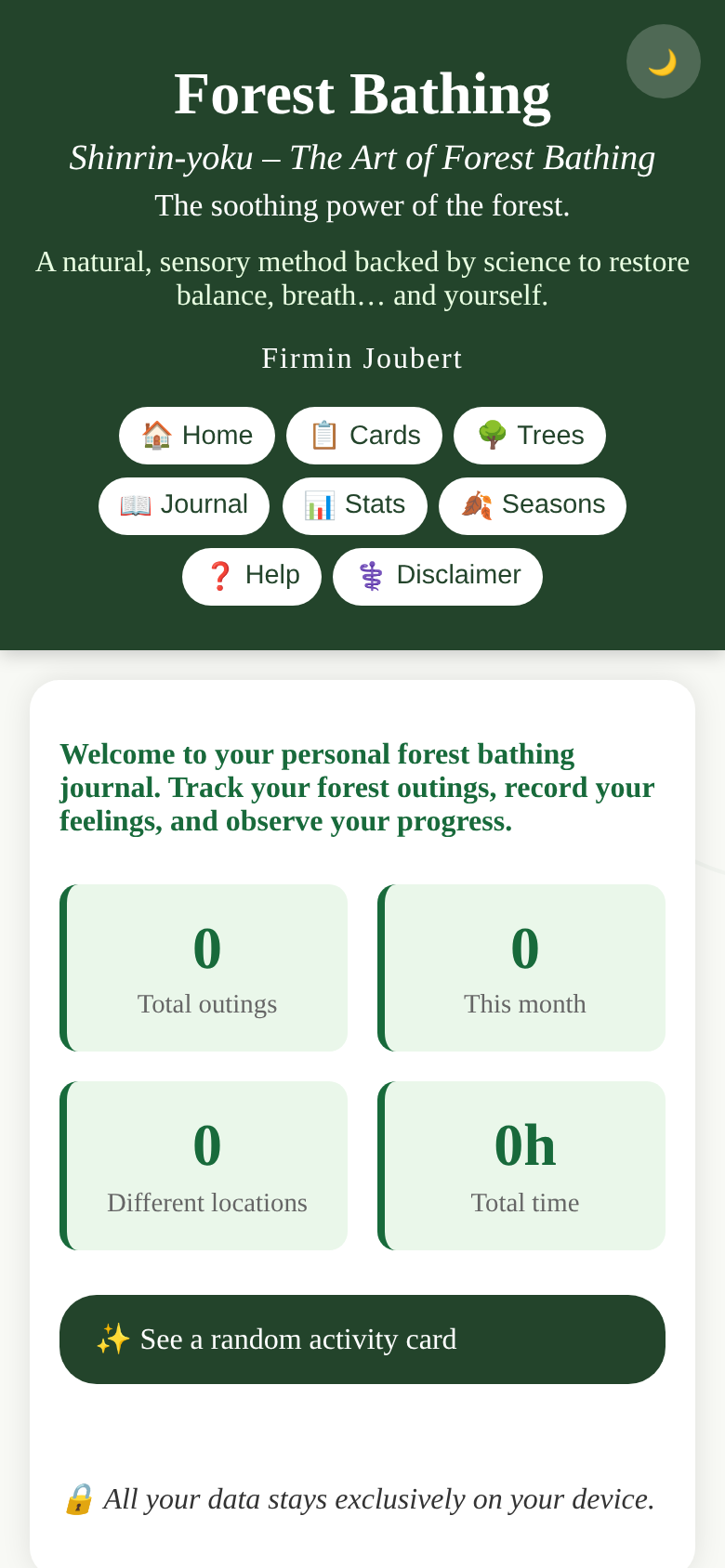
- A free app that collects nothing. Works offline once opened (only weather and maps need a connection). No account, no sign-up, no tracking. Nothing the reader writes ever leaves their phone. In 2026, that is itself a story.
Book Facts
| Title | Forest Bathing — Shinrin-Yoku, the Forest Therapy |
| Subtitle | A sensory practice, grounded in science, for anyone willing to stand still under a tree |
| Author | Firmin Joubert |
| Edition | Second edition, revised and expanded (2026) |
| Pages | 118 paperback (6 × 9 in.) · 135 hardcover |
| Word count | approx. 27,600 |
| ISBN (paperback) | 979-8197041203 |
| ISBN (hardcover) | 979-8174756199 |
| Formats | Paperback, Hardcover & Kindle (Amazon KDP) |
| US list prices | Paperback $15.99 · Hardcover $19.95 · Kindle $4.99 |
| Category | Health & Wellness · Nature · Mind & Body |
| Market | United States |
| French edition | La Sylvothérapie — Le shinrin-yoku, le bain de forêt |
What Is New in the Second Edition
- A new opening chapter — the author’s childhood in Le Puy-en-Velay, and what he was actually given there.
- Five interludes — short first-person pieces between the chapters: a hundred-year-old oak in a Lyon public park; six lines from his tai chi teacher he has never improved upon; the day the practice failed; a cellar, a red light, and a barber; and why he began to write so late.
- “Thirty Days in the Forest” — a thirty-day path the reader can begin tomorrow with five minutes and a single tree.
- A full bibliography — twenty foundational references, so every claim can be checked.
- A chapter on the evidence, honestly — including what the research does not yet show.
Quotes for Publication
“The first twenty minutes are boring. Nobody tells you that.”
“I am not a doctor. I am a man who noticed something under some trees near Lyon, and spent the next thirty years finding out why.”
“Stay longer than you want to.”
“There is probably a tree within a mile of you, and it is probably older than you are.”
“Take your time. Nobody is in a hurry for you to become anything.”
What the Research Shows
The book reports the published literature and is explicit about its limits. It is a wellness book, not a medical text, and it says so on the copyright page.
- Cortisol. A 2019 systematic review and meta-analysis (Antonelli, Barbieri & Donelli, International Journal of Biometeorology) found measurable reductions in salivary cortisol after forest exposure.
- Cardiovascular. Park, Tsunetsugu, Kasetani, Kagawa & Miyazaki (2010) measured lower blood pressure and heart rate across field experiments in twenty-four Japanese forests.
- Immune activity. Qing Li, immunologist at the Nippon Medical School in Tokyo, documented increased natural killer cell activity following multi-day forest immersion.
- Brain. Sudimac, Sale & Kühn (2022), Molecular Psychiatry: amygdala activity decreased after a one-hour walk in nature; a comparable urban walk showed no such effect.
The book makes no therapeutic claim, promises no cure, and states plainly that forest therapy is a complementary wellness practice, not a medical treatment.
The Companion App
The book offers two journals, and the reader chooses.
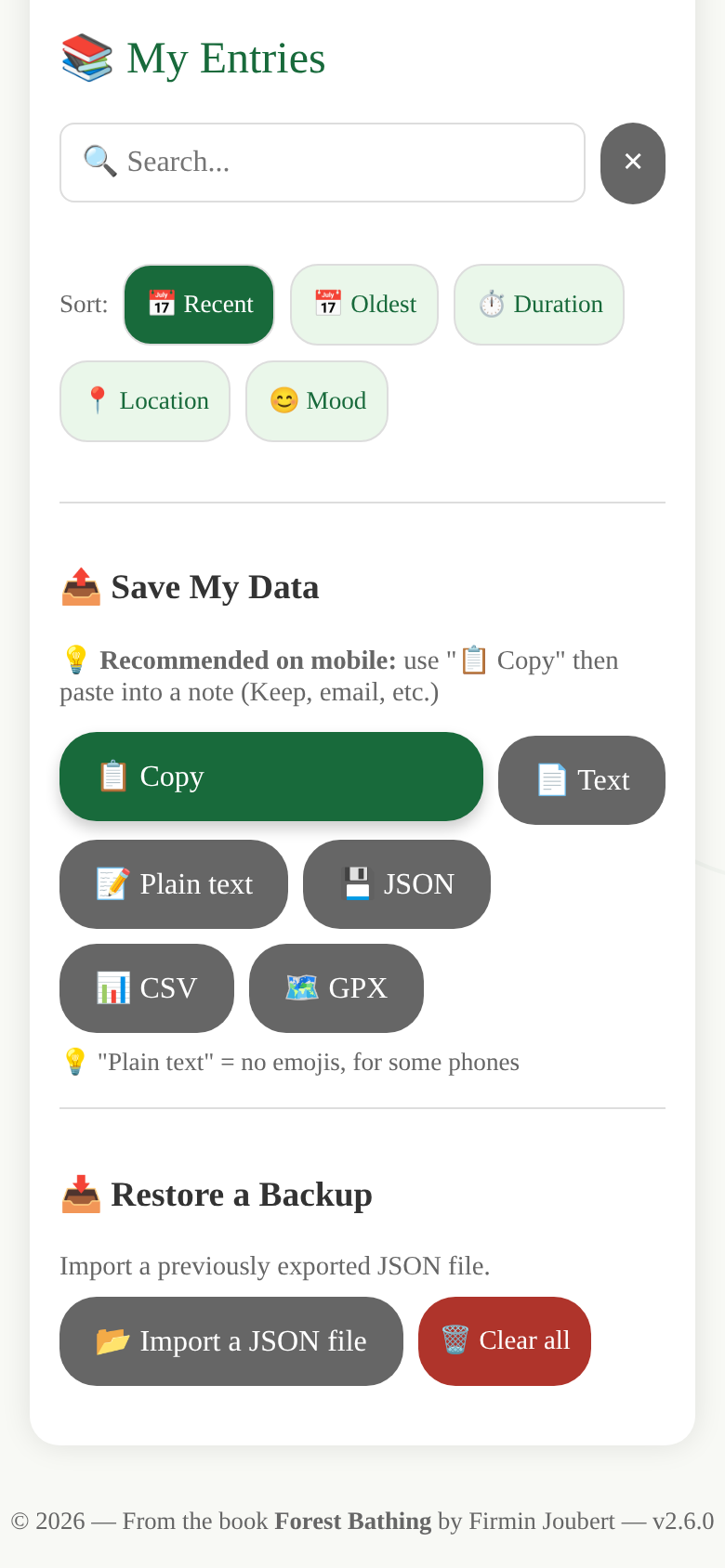
One is digital. A free companion app, free forever, built for readers of the book.
- Works offline once opened (except weather and maps)
- No account, no sign-up, no tracking
- Nothing the reader writes ever leaves their phone
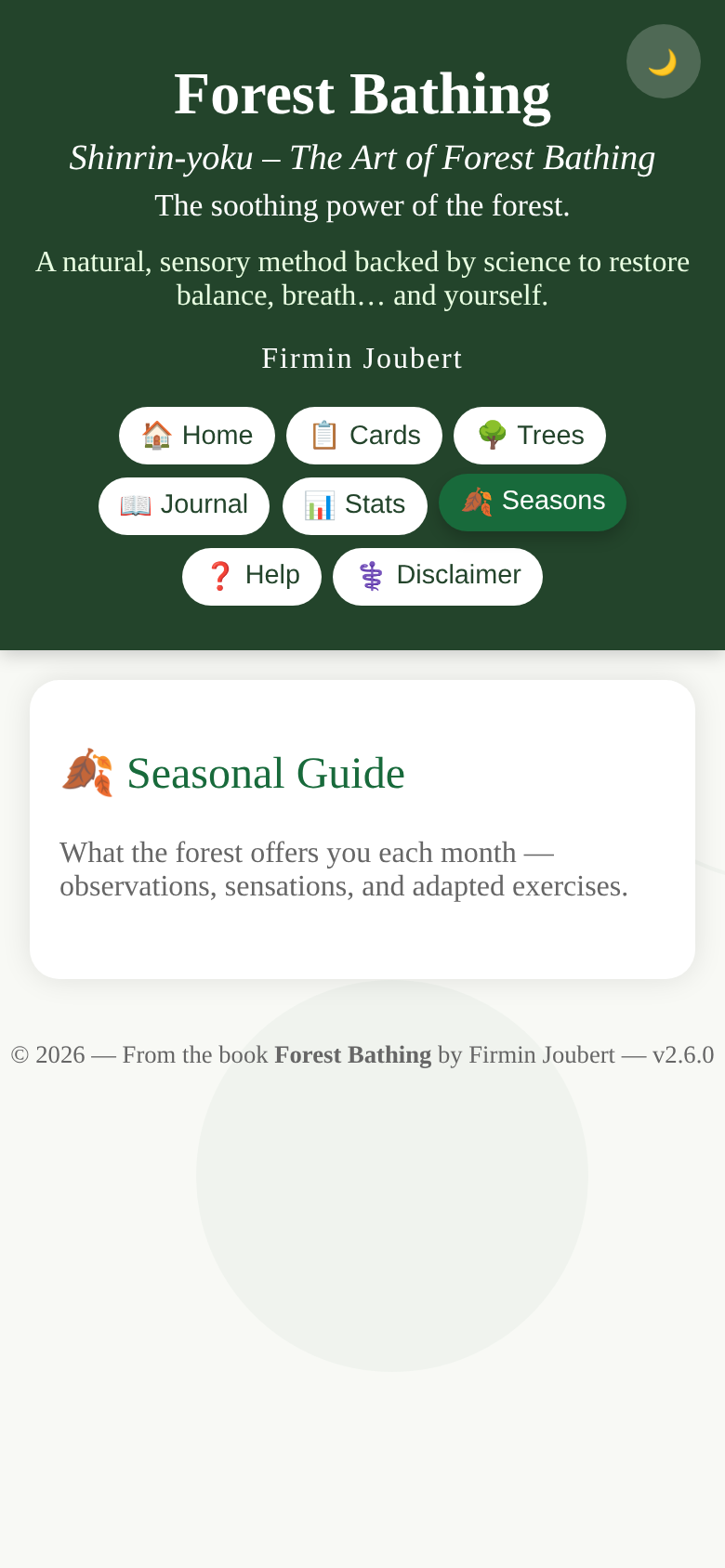
- Text and voice entries, photos, mood before/after; a map of your walks; a 50-tree field guide; seasonal prompts
- Free forever, for every reader
The other is paper. Fourteen pages bound into the book itself, for anyone who would rather use a pen. It is a book, and a book can be written in.
About the Author

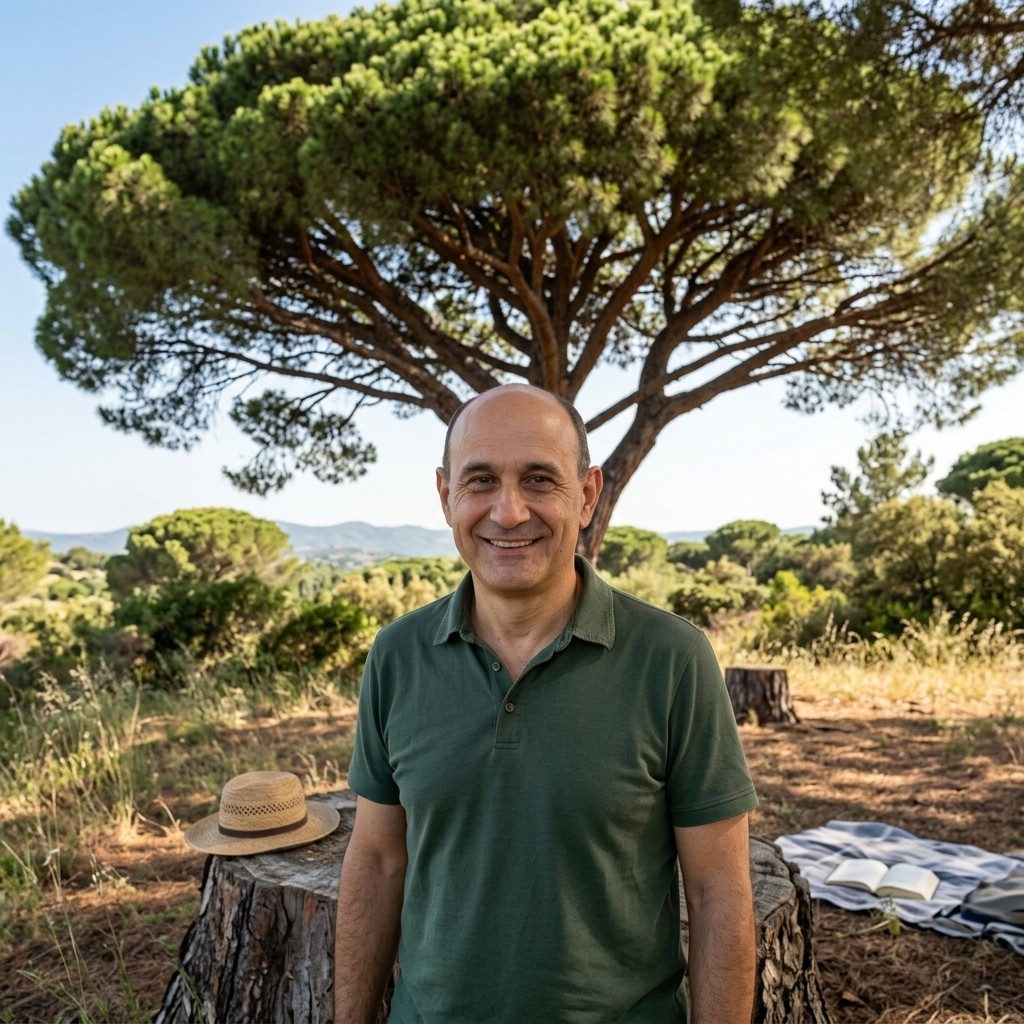
Images for Press Use
Free to reproduce in connection with coverage of the book. Credit: Firmin Joubert.


Media Contact
Firmin Joubert
Write to me directly: firmin.joubert@gmail.com
Review copies (PDF), interviews, excerpts and images — or use the contact form (select “Request a PDF”).
Please note: the author writes in French; the book was carefully adapted into US English. Interviews are conducted in writing — he answers every question personally.
Assets available on request: cover images (high resolution), author photograph, app screenshots, a 500-word excerpt, and the full press release.